Local Angle: How to Photograph UK Coastal Towns for a Travel Portfolio
British seaside towns punish the obvious shot. Arrive at noon in August, stand on the promenade, fire off a wide frame of the pier and you will come home with something flat and forgettable. Return at six in the morning, when the beach is being raked and the gulls are working the litter bins, or on a wet Tuesday in February when the arcade shutters are down and the light is the colour of slate, and the same town will give you something worth keeping.
Shooting a coastal portfolio is mostly a matter of paying attention to three things: water, light, and the small human evidence in between. Here is how to work a British seaside town properly.
Plan around the tide, not your arrival time
Tides shape everything. Check a tide table before you book the train, not after you reach the harbour wall. High water comes roughly every twelve and a quarter hours, which means the good low-tide window slides about fifty minutes later each day — useful if you are staying for a long weekend and want two different versions of the same beach.
What you get changes with the water level. Low tide exposes groynes, rock pools, weed-covered slipways, stranded dinghies and the wide reflective sheets of wet sand that make a coastal frame feel enormous. High water compresses the scene: boats ride level with the quay, steps disappear, waves come close to the promenade railing and the town feels tighter and more enclosed.
Treat the sea with respect. Tidal ranges around the UK vary enormously, from a metre or so on some sheltered beaches to many metres in the Bristol Channel and parts of the north-west. Check times for the exact beach you plan to shoot, keep an eye on the water rather than your viewfinder, and avoid walking out onto mudflats or along tidal causeways without knowing when the water returns.
Read the light coast by coast
Which way does the coast face? On the east coast — Yorkshire, Lincolnshire, Norfolk, much of Scotland's east — the sun rises out of the sea and sets behind the town. On the west coast it is the reverse, which is why a harbour in Cornwall, Cumbria or Argyll gives you sunset over water and sunrise over rooftops.
British coastal light is at its best when it is doing something. Sea fret and haar roll in and soften a headland into layers, so take the long view rather than packing up. Flat overcast is not bad weather; it is ideal for painted doors, peeling paint, pebble texture and wet rope, because there are no blown highlights to fight. And the half-hour after rain gives you cobbles and promenade tiles acting as mirrors.
Midsummer midday is harsh and unflattering, so use it deliberately: step inside the chip shop, the amusement arcade, the harbour shed, the lifeboat station. Working interiors are as much a part of a seaside town as its skyline.
Architecture that repays a camera
Piers, promenades and shelters
Approach a pier as a graphic object first. A short telephoto from a distance compresses the ironwork into a dense pattern; standing underneath it at low tide gives you rust, rivets and shadow. Look for the sweep of a curving promenade, the geometry of white railings, the Victorian bandstand, the stepped sea wall. Straight-on framing, with the horizon dead level, beats a tilted angle almost every time.
Harbours and working quays
Working harbours are more interesting than marinas. Creels stacked on the quay, ropes coiled on bollards, fish boxes, the trail of a boat's wake at first light — this is the material that tells a reader what a place does for a living. Early morning is the hour to be there, when boats come in and the light is low and warm.
Terraces, fronts and beach huts
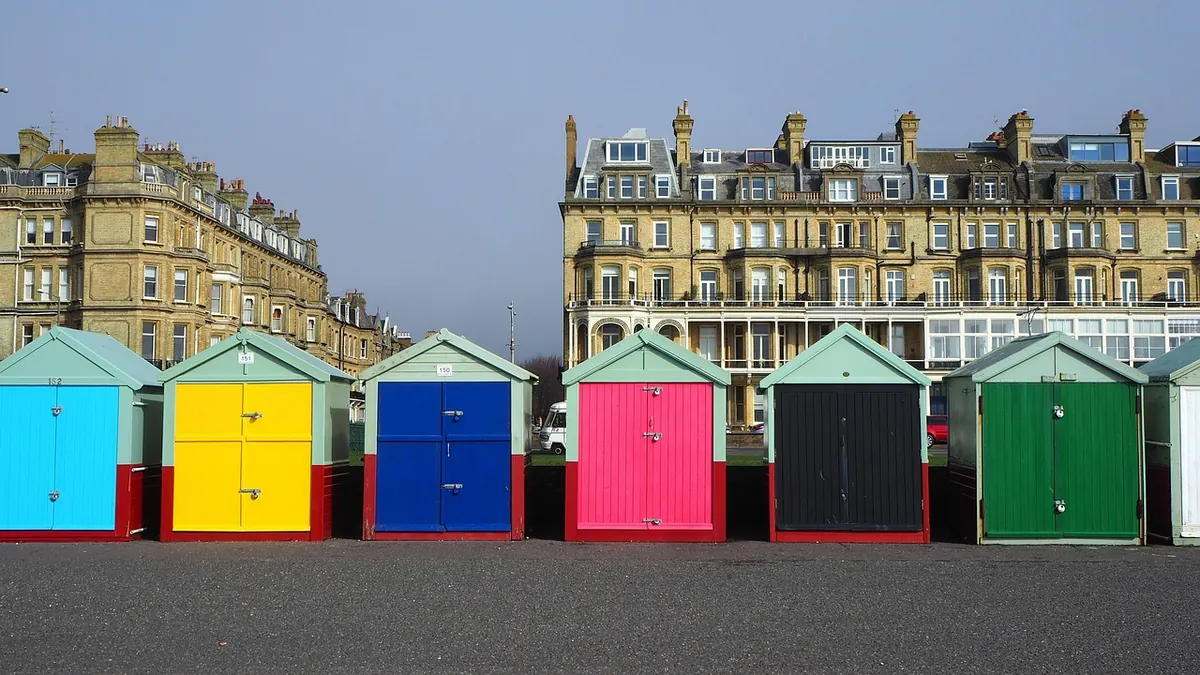
Curved Georgian terraces, gothic revival hotels, art deco lidos and rows of painted beach huts all reward repetition. Step back and shoot the pattern; step in and shoot one section against the sky. Ignore the temptation to straighten away every bit of character — a leaning chimney or a rusted railing is information.
Details at street level
Between the big views live the frames that make a portfolio feel personal. Hunt for:
- Hand-painted shopfront lettering and fading fascias
- Striped awnings, deckchair stacks and folded parasols
- Nets, floats, buoys and creels hung on a wall
- Steam from a chip shop window, vinegar bottles lined up on a sill
- Wet railings, bench plaques, house names on painted gates
- A pastel wall meeting a bright door, two colours and nothing else
- Seaweed lines and salt marks that show how high the water reached
Shoot one subject per frame. Move closer than feels natural, then closer again. A 35mm or 50mm lens keeps the proportions honest, and a quick check of the scene's edges saves you cropping out stray bins and wheelie signage later.
People, permission and pace
Seaside towns are full of people doing photogenic things, and most of them will say yes if you ask. Harbour workers are generally pleased to be asked rather than photographed sideways, but they are also busy, so a short question at a quiet moment works far better than a long conversation. If you would rather not approach anyone, wait for silhouettes, backs, hands and reflections instead — a swimmer crossing a frame at the right moment is worth an hour of standing still.
Be careful with children. Photographing identifiable young people without a parent or guardian's agreement is not worth the argument, and group shots at the beach work perfectly well as distant figures or cropped detail.
Keeping the set consistent
Two lenses will cover a coastal town: something wide in the 24–35mm range for promenades and harbour walls, and a short telephoto around 85–135mm for compression and detail. Add a polariser for water and wet sand, a cloth for salt spray, and a bag for the spray you did not plan for.
When it comes to editing, resist heavy colour grading. British seaside colour is already specific — chalky pastels, oxidised green railings, rust, grey-blue water, a shriek of neon from the arcade. Keep those hues intact and your portfolio will look like one place rather than six presets. Sequence your final edit as a walk: a wide establishing frame, a mid-distance architectural shot, a few details, one human moment, then a closing view out to sea.
A working day in a coastal town
- Check the tide table and sunset time the night before, and set the alarm accordingly.
- Arrive before sunrise and walk the town once without the camera, noting the good corners.
- Shoot the harbour and beach through the first two hours of light.
- Use the harsh middle of the day for interiors, arcades and shopfronts.
- Return to a chosen spot for the last ninety minutes of light.
- Back at your desk, note the place, date and tide state against each file.
Labelling images with location and date as you go costs five minutes and saves an afternoon later. It also keeps a portfolio honest: a viewer can tell the difference between a town you visited and a town you actually looked at.
Photo: Primrose / Pixabay