Seasonal Art Challenge: How to Create a Winter Sketchbook Series
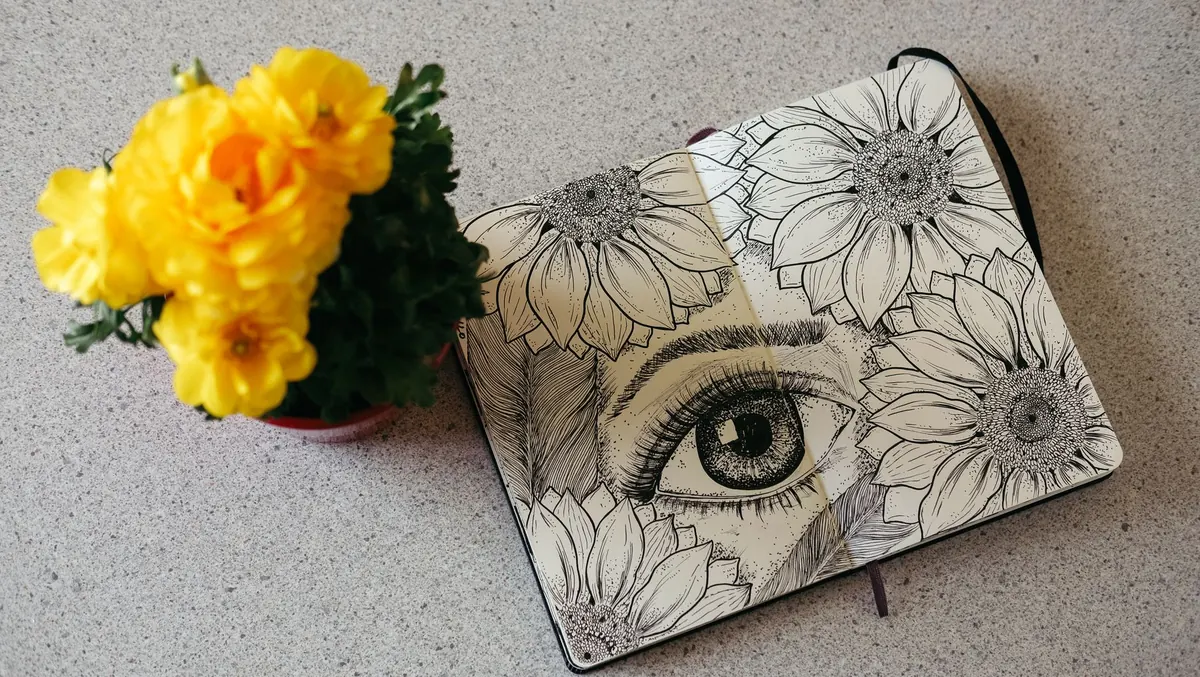
Winter gets a bad press in sketchbook circles. The light goes flat by three o'clock, the garden is a tangle of dead stems, and nobody wants to sit on a cold bench drawing a fountain. Yet the season hands you something summer never does: repetition. The same window, the same mug, the same walk to the shops in the dark, over and over for three months. Repetition is exactly what a series needs.
A winter sketchbook series is one book filled to a self-imposed brief. Twenty to forty pages, a limited palette, a handful of subjects you keep returning to. The result looks deliberate rather than accidental — and if you scan and sequence it well, it doubles as a portfolio update at the quietest point in the year.
Why a series beats a stack of one-offs
Most sketchbooks are accumulations. You draw whatever is in front of you, in whatever medium is nearest, and the book becomes a record of scattered afternoons. There is nothing wrong with that, but it rarely reads as a body of work.
A series works differently because the decisions are made in advance. You have already chosen the paper, the palette and the subjects, so each session is spent drawing rather than deciding. On a dark Tuesday evening in February, when motivation is thin, a brief removes the blank-page question entirely: the kitchen window, two greys and a warm yellow, twenty minutes.
The payoff is cohesion. Twenty pages that share a palette and a set of motifs look intentional, even when some of them are rough.
Set your constraints before you make a mark
Constraints do the heavy lifting, so write them on the inside cover and treat them as fixed:
- One book. A 15 cm square with smooth 140 gsm paper takes pen and light washes without buckling. A larger landscape book suits charcoal and broad tonal shapes. Pick one size and stay in it.
- Two media, maximum. Ink and gouache. Pencil and white chalk. Charcoal and a soft grey marker. Two is enough to keep pages related and stops you restocking halfway through.
- Four colours plus white. A cool blue-grey, a warm ochre, a dark, and one accent you use sparingly. Note the names inside the back cover.
- A quota you can hit on a bad week. Three pages, or twenty minutes a day. Aim low and beat it.
- Five to seven motifs you are genuinely happy to draw again.
An eight-week rhythm that actually holds
Weeks one and two: gather and test
Fill the first two spreads with colour mixes, swatches and thumbnail compositions. Test how the paper behaves with a wet brush, a dry brush and a loaded nib. Nothing here needs to be finished — these pages become your reference, and they will look good in the final edit because they are honest working notes.
Weeks three to six: the bulk of the book
This is the series. Three or four pages a week is plenty. Work in short sessions rather than one long one; twenty minutes a day for a week will teach you more about a subject than a single three-hour sitting. Draw the same object from two angles on facing pages. Draw it badly on purpose once. Draw it again in only two values.
Weeks seven and eight: push and edit
Choose four or five pages with something going for them — a strong shape, a good crop, a colour that sings — and take them further. Add a second layer. Darken the foreground. Redraw one at double size on separate paper. Then close the book for a few days before you judge any of it.
Subjects that stay interesting until March
- One window at a fixed hour, drawn every few days in different weather.
- Steam, kettles, mugs, a pot on the hob — reliable, and ideal for soft edges.
- A single tree from the same spot, in rain, frost and low sun.
- Winter clothing: gloves on a radiator, boots by the door, a scarf over a chair.
- Reflections in wet pavements, bus windows and shallow puddles of ice.
- Food with structure: citrus peel, a halved cabbage, a bowl of walnuts.
- Interiors at night — lamps, bookshelves, a radiator, a sleeping cat.
- Frost patterns and condensation, drawn close up and quickly.
Keeping the pages looking like a set
Cohesion is mostly a matter of repeating small decisions. Choose a few of these and apply them to every page:
- Keep a margin of the same width throughout.
- Use one colour for all line work.
- Repeat a single shape — a circle for lamps, a rectangle for windows.
- Title and date each page in the same corner, in the same hand.
- Let some pages stay unfinished. White space reads as a decision when it appears consistently.
- Work across spreads occasionally so the book has rhythm instead of a grid of isolated squares.
From sketchbook to portfolio
When the book is full, photograph or scan each page flat in daylight, avoiding hard shadows and the shadow of the binding. Crop every image the same way, so the sequence looks even. Then edit hard: eight to twelve pages is a strong portfolio set. More than that and the viewer stops reading it as a series.
Sequence by subject rather than by date, and open with your strongest image — not necessarily the most finished one. Write a short paragraph to sit alongside it, stating the brief: the palette, the number of weeks, the motifs you chose. That context is what separates a project from a pile of drawings.
Show the book as an object too. One flat-lay of an open spread, one scanned page presented on its own, and the viewer understands both the series and the individual drawing.
Start with one page tonight
Use a book you already own. Write your constraints on the inside cover — one book, two media, four colours, three pages a week — and draw the nearest window in twenty minutes without tidying it up. That is the whole project, repeated until spring.
Keep the series small enough to finish. A completed twenty-page winter book is worth more to your portfolio than an ambitious fifty-page one that stalls in January, and it gives you a genuine reason to be at the desk during the months when the light is poor and the evenings are long.